
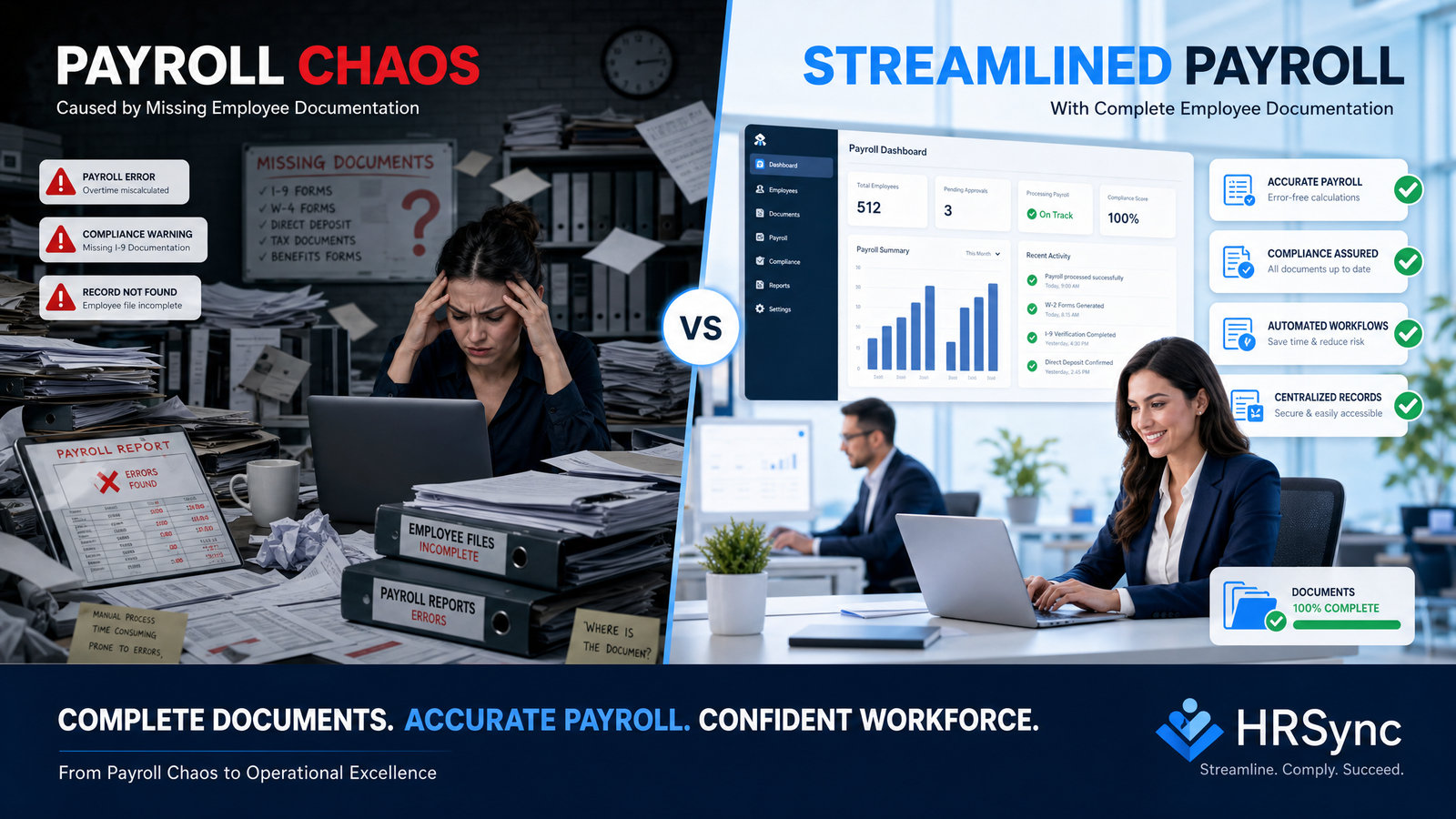
Employee Documentation in India: Backbone of Payroll & Compliance
Employee documentation in India is the foundation of payroll compliance. Learn how proper records prevent payroll errors, penalties, and audit risks.
Why Employee Documentation Is the Backbone of Payroll & Compliance in India?
Payroll involves much more than paying salaries. While most people think payroll is only math and numbers; in reality, a good payroll starts with good documentation. Employee information and records help businesses calculate pay, taxes, and benefits correctly. If any document is missing or incorrect, it can cause wrong statutory deductions, notices from the authorities, or trouble during audits. In India, payroll links closely to labour laws and compliance. Accurate employee documentation in India ensures businesses follow all rules and do not face penalties or legal risk. Good records protect both the employer and the employee.
What Is Employee Documentation?
Employee documentation is all the papers and digital records a business keeps about a worker. These papers show who the employee is, when they joined, what they are paid, and what benefits they get. Good documentation ensures accurate payroll processing and proper payroll compliance with Indian labour laws.
Categories of documents
-
Pre-joining documents: These are collected before someone officially joins. Example: ID proofs, signed offer letter.
-
Statutory & compliance documents: These include PF and ESI declarations, nomination forms, and KYC details like PAN or Aadhaar. These show compliance requirements from the start.
-
Payroll-linked records: These are attendance, leave, salary structure, deductions, and bank details. They help ensure accurate payroll calculations.
-
Exit-related documents: These include resignation letter, relieving letter, and full & final settlement documents.
Documentation must be accurate, complete, and updated for every employee. Missing or wrong information can lead to payroll errors and compliance risks.
The Direct Link between Employee Documents & Payroll Accuracy
How documents impact payroll calculations
-
Salary structure based on offer letters: Payroll needs clear salary details from the offer or appointment letter.
-
Attendance and leave affecting wages: Hours worked, leaves taken, and attendance records decide monthly pay and leave encashment.
-
Bank details for salary disbursement: Organizations must have correct bank account information for on-time payouts.
Examples of Payroll Errors Caused by Poor Documentation
-
Wrong salary credits: If salary structure details are wrong, employees get too much or too little pay.
-
Overpayments or underpayments: Incorrect leave or attendance records cause wrong payouts.
-
Delayed payroll cycles: Missing bank or tax information can delay payroll process in India.
Having all employee master data in one organized database helps payroll teams trust the data and reduce mistakes.
Employee Documentation & Statutory Compliance in India
How Documentation Ensures Compliance with Indian Labour Laws
-
Provident Fund (PF): In India, employers with 20 or more employees must register for PF and record employee details for pension and savings. Contributions require monthly filing.
-
ESIC: If a business has more than 10 employees (20 in some states), it must register for ESIC for health and insurance benefits. Documentation like employee list and wages is needed.
-
Professional Tax: States levy professional tax, and employers must deduct and submit it based on employee records.
-
Labour Welfare Laws: Various labour laws in India require employers to maintain attendance, wage, and leave registers.
Key Statutory Documents Required
-
Offer/ appointment letters: These are the basic proof of employment and salary terms.
-
Nomination forms (Form 2, Form F, etc.): For PF and pension benefits, employers file nomination forms when employees join.
-
KYC documents: PAN, Aadhaar, and bank details are needed for statutory filings and tax purposes.
Consequences of Missing or Incorrect Records
-
Penalties: If records are missing or late, authorities like EPFO or ESIC can punish employers.
-
Interest on delayed contributions: Late PF/ESIC contributions lead to interest charges and additional damages.
-
Inspection and audit risks: Labour inspectors can check records at any time. Poor documentation for payroll can lead to issues and fines.
Critical Employee Documents Every Employer Must Maintain
Joining & Employment Documents
These include:
-
Offer letter, appointment letter
-
Confirmation letters
-
Employment terms and conditions
Statutory & KYC Documents
These include the following:
-
Aadhaar, PAN, ID proofs
-
Nomination forms
-
PF & ESIC declarations
Payroll & Attendance Records
These include:
-
Attendance and leave data
-
Salary structures
-
Deductions and reimbursements
Exit & Separation Documents
These include:
-
Resignation letters
-
Full & Final settlement records
-
Experience/relieving letters
Maintaining these payroll compliance documents helps employers stay audit-ready.
Common Documentation Mistakes Businesses Make
-
Missing nomination forms
-
Outdated employee master data
-
Manual records with no backups
-
Inconsistent document formats
-
No audit-ready documentation
-
Why these mistakes usually surface during inspections or disputes
Best Practices to Build a Strong Documentation System
-
Maintain a structured employee master database
-
Digitise and store records securely
-
Update documents during salary revisions, transfers or when an employee exits
-
Regular internal documentation audits
-
Assign clear HR and payroll responsibility
Digital records reduce manual errors and make retrieval easy for audits.
How Professional Payroll & Compliance Support Helps
Many businesses choose professional payroll compliance services in India for managing documentation and compliance. These services help with:
-
Reduced compliance risk
-
Audit-ready records
-
Peace of mind for business owners
A payroll expert can help coordinate between HR, payroll, and statutory filings smoothly.
Strong Documentation Equals Stress-Free Payroll
Managing employee documentation is not easy, especially when teams grow and laws keep changing. Employee documentation is not just paperwork. It is protection. With accurate records, payroll becomes smooth. Businesses avoid legal trouble. Employees receives payments correctly and on time. Good documentation builds trust and keeps compliance steady. Start early and keep records updated to avoid penalties and audits.
At Kriotech, we work with organizations across different industries to help them build and maintain strong employee documentation systems. Our team supports businesses in setting up complete employee files, updating records at every stage of the employee life cycle, and aligning documentation with payroll and statutory compliance needs. We set a simple goal of helping businesses reduce compliance risk, run payroll smoothly, and stay focused on growth, while we take care of the documentation backbone behind it.
Speed Optimized

Types of Employment Letters in India Explained Simply
Understand the importance of each types of employment letters in India.
- Factory HR & Compliance Management
Understand the importance of each types of employment letters in India.