
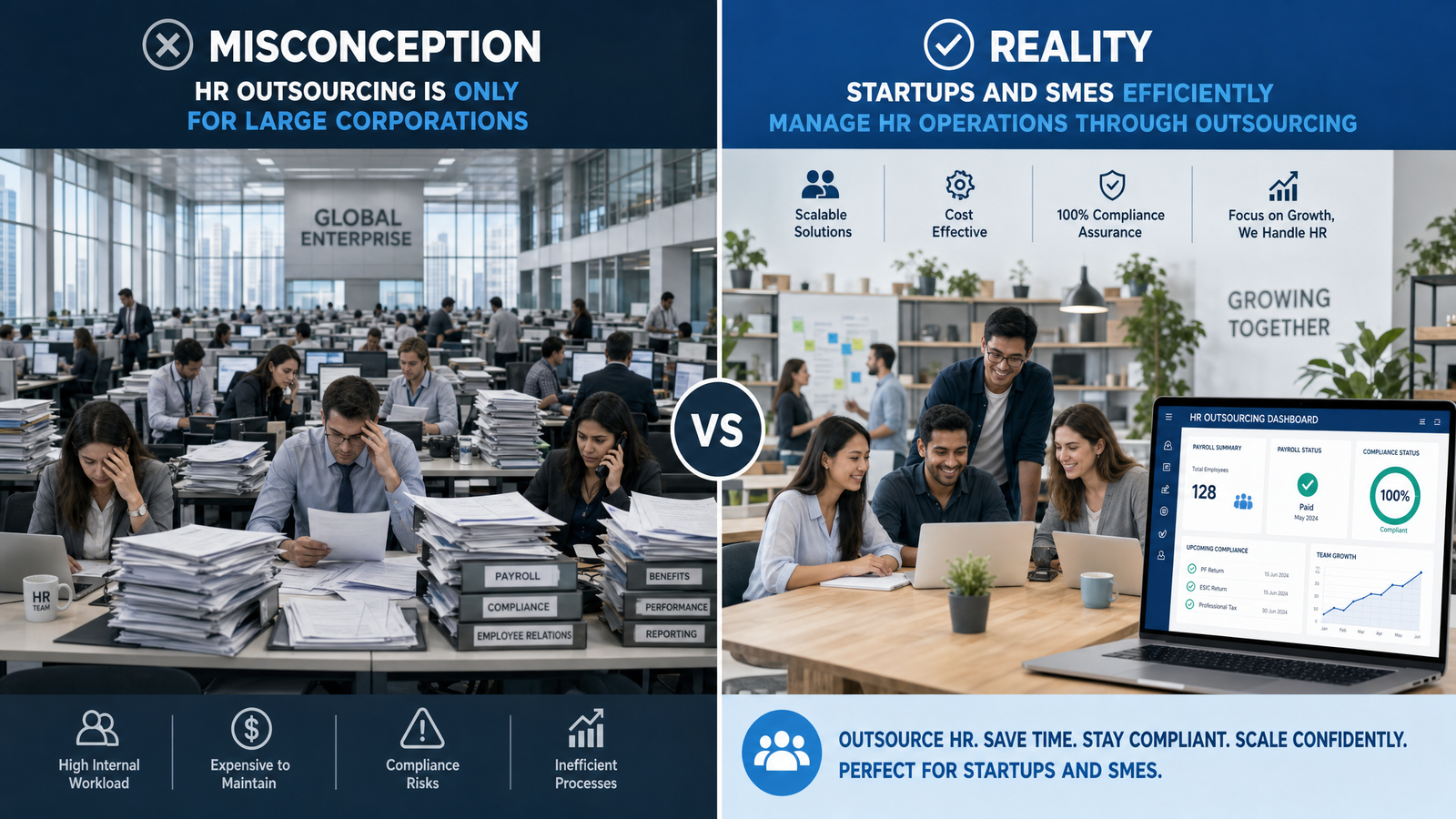
Is HR Outsourcing Only for Large Companies? A Reality Check
HR outsourcing isn’t only for large companies. Learn why HR outsourcing for small businesses, startups, and SMEs in India makes practical and compliance sense.
Many people believe HR outsourcing is only for large corporations. This belief is very common in India. Small and growing companies often think outsourcing HR is too expensive or too complex for them. They assume it works only at a big scale. This misunderstanding causes delay. Smaller companies try to manage HR on their own for too long. Problems appear slowly. Payroll errors. Compliance stress. Missed filings. This blog clears that confusion. It explains what HR outsourcing really means today. It shows why HR outsourcing for small businesses is not only possible, but often more useful than for large firms.
Where the “Only for Large Companies” Myth Comes From
The myth did not appear without reason. Large enterprises adopted outsourcing early. They had big payroll teams and multi-location operations. Their outsourcing contracts became visible in the market.
Many people saw HR outsourcing only through that lens. They assumed it involved huge contracts and long-term lock-ins. Cost and scope got misunderstood. Another reason is confusion between outsourcing and consulting. Consulting offers advice. Outsourcing handles daily execution. Small companies often mix the two. Because of this, HR outsourcing for startups in India stayed misunderstood for years.
What HR Outsourcing Actually Means Today?
HR Outsourcing Explained Simply
HR outsourcing means giving specific HR work to an external partner. The partner manages the work using systems and processes. The company still controls decisions. Some businesses outsource only payroll or compliance. Others outsource the full HR function. This includes documentation, payroll, statutory filings, and exits.
How HR Outsourcing Has Changed Over Time
Earlier, outsourcing focused on large enterprises. Today, models are flexible. Services are modular. Companies choose only what they need. This shift made HR outsourcing for SMEs practical and affordable. It is no longer an all-or-nothing model.
Why Large Companies Use HR Outsourcing?
Large companies outsource HR for scale and consistency. They manage employees across many locations. Labour laws differ by state. Outsourcing helps manage that complexity. They also want standard HR processes across teams. Outsourcing supports uniform systems.
Risk management matters too. Large firms face frequent audits. HR outsourcing keeps documentation ready. Even here, the goal is not size. It is control and risk reduction.
Why Small and Mid-Sized Companies Actually Need HR Outsourcing More
Limited HR Expertise In-House
Small teams usually have one HR generalist. That person handles hiring, payroll, compliance, and admin work. Indian labour laws are complex. One person cannot track everything.
Higher Compliance Risk Exposure
Penalties hurt small companies more. A fine or notice can disrupt cash flow. Large firms absorb shocks better. This makes HR outsourcing for small businesses a safety net.
Cost Pressure and Hiring Constraints
Hiring a senior HR professional costs a lot. Many SMEs cannot afford that. Outsourcing gives access to expertise without full-time hiring.
This is why HR outsourcing for SMEs often makes more sense than building in-house teams.
HR Outsourcing Use Cases Beyond Large Enterprises
Startups and Early-Stage Companies
Founders handle HR themselves at first. Payroll and compliance take time away from growth. Outsourcing helps founders focus on the core business. This is a common reason for HR outsourcing for startups in India.
Growing SMEs
As teams grow, compliance pressure rises. Payroll errors increase. Documentation gaps appear. Outsourcing stabilises operations during growth.
Multi-State Operations
Operating across states means different labour laws and filings. Outsourcing partners manage this complexity better than small internal teams.
What HR Outsourcing Looks Like for Smaller Companies
HR outsourcing for smaller companies looks different from enterprise models.
Many use partial outsourcing. Payroll and compliance come first.
Pricing stays flexible. Scope grows with the business.
There is no loss of control. Companies approve actions. Partners execute tasks.
This model makes HR outsourcing for small businesses practical and scalable.
Common Concerns Small Businesses Have About HR Outsourcing
We’ll Lose Control: This fear is common. In reality, companies keep decision authority. Outsourcing handles execution, not leadership.
It Will Be Too Expensive: In-house HR includes salary, training, and attrition costs. Outsourcing spreads cost across services. For many, HR outsourcing for SMEs costs less than one HR hire.
Our Needs Are Too Small: Modern outsourcing is modular. Small needs still qualify. This is why HR outsourcing for startups in India keeps growing.
When HR Outsourcing Makes Sense Regardless of Company Size
-
Size does not decide readiness. Situations do.
-
Compliance complexity pushes companies toward outsourcing.
-
Headcount growth increases HR workload.
-
Founder bandwidth reduces quickly.
-
Audit exposure rises over time.
In all these cases, HR outsourcing for small businesses works as a preventive step, not a reaction.
How to Decide If HR Outsourcing Is Right for Your Business
Questions Founders Should Ask
-
Are compliance tasks consuming time?
-
Are payroll errors frequent?
-
Is HR slowing down growth?
If the answer is yes, outsourcing deserves attention. Businesses should review HR setup every year. Growth changes needs fast. This applies equally to HR outsourcing for startups in India and HR outsourcing for SMEs.
HR Outsourcing Is About Need, Not Size
HR outsourcing is not about company size. It is about readiness, risk, and growth stage. Large companies outsource for scale. Small companies outsource for survival and stability. The myth that outsourcing suits only big firms no longer holds. Today, HR outsourcing for small businesses helps reduce compliance risk, improve payroll accuracy, and free up leadership time. Businesses should reassess their HR setup regularly. At Kriotech, we support startups and SMEs with practical HR outsourcing that fits their size today and scales with them tomorrow.
Speed Optimized

Form 2, Form F & Other PF Nomination Forms Explained
A simple employer guide to PF nomination forms like Form 2 and Form F. Learn when to collect them, why they matter, and how to stay compliant.
- Licensing & Statutory Registrations
A simple employer guide to PF nomination forms like Form 2 and Form F. Learn when to collect them, why they matter, and how to stay compliant.