
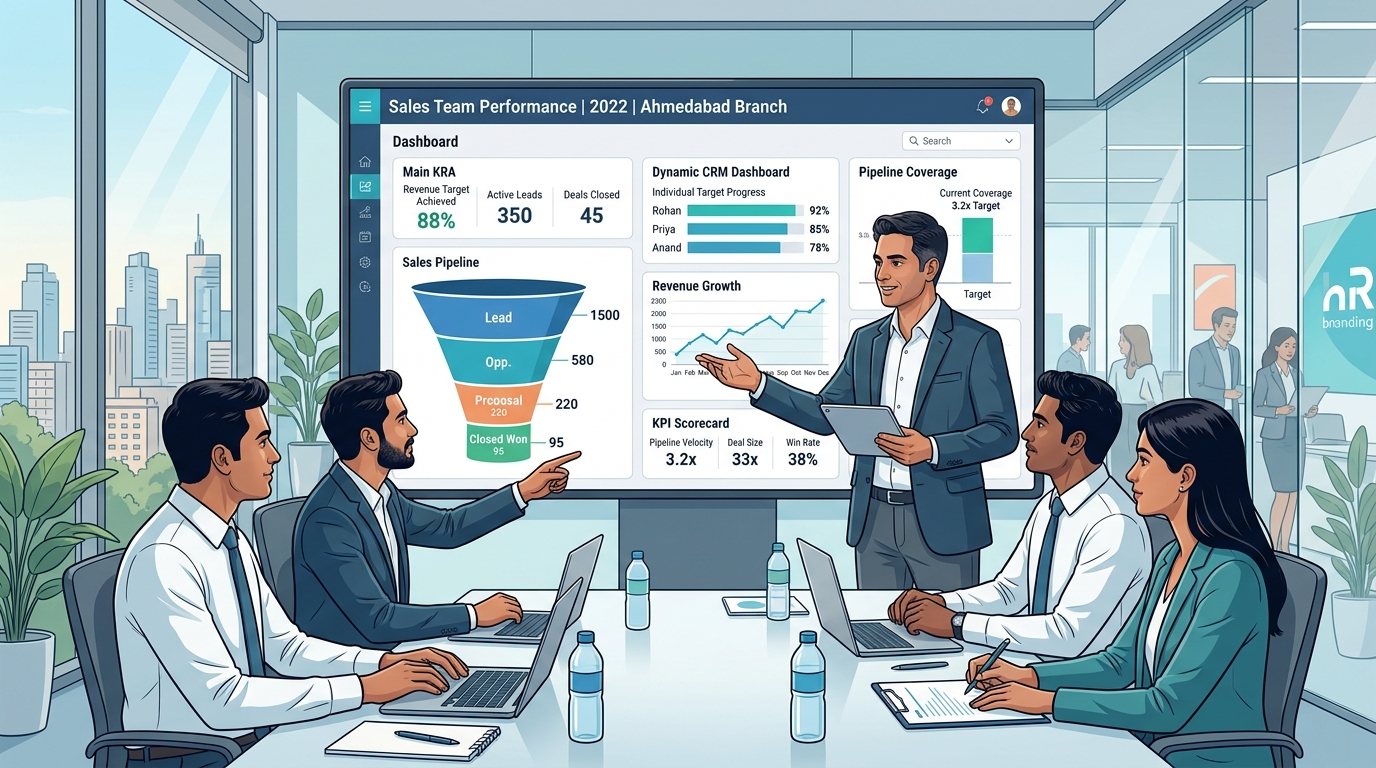
Performance Management for Sales Teams in India: KRAs and KPIs That Work in 2022
Discover how to build effective KRAs and KPIs for sales teams in India in 2022 to improve revenue predictability, pipeline visibility, and sales performance management.
The sales function is the most frequently KPI-measured function in Indian businesses - and simultaneously the one with the most common KPI design failures. Business owners who would not dream of assessing an accountant without looking at the accounts routinely assess their sales teams on vague metrics like 'customer relationships,' 'market presence' and 'effort.' In 2022, with sales team attrition running high and the connection between sales performance management and revenue predictability more important than ever, getting sales KPIs right is a revenue-critical management decision.
The Sales Performance Management Gap in Indian Businesses in 2022
In most Indian SMEs, sales performance is managed through monthly target reviews - typically a conversation about total revenue against target, with little structure around pipeline quality, activity breakdown, customer retention or individual skill development. This narrow measurement model creates three predictable problems: first, it provides no early warning system for revenue shortfalls (problems are visible only at month end). Second, it cannot differentiate between a sales shortfall caused by effort, skill, market conditions or product issues. Third, it creates a performance conversation that is entirely backward-looking.
Building a Comprehensive Sales KRA and KPI Framework
KRA 1: Revenue Generation
KPIs: Monthly revenue vs target, revenue growth rate vs prior year, revenue from new accounts, revenue from existing accounts (retention revenue), average deal size.
KRA 2: Pipeline Management
KPIs: Total pipeline value vs 3x monthly target (pipeline coverage ratio), number of active opportunities at each stage, average sales cycle length, stage conversion rates from lead to opportunity to proposal to close.
KRA 3: Customer Acquisition
KPIs: Number of new customers acquired, cost per new customer, new customer revenue as percentage of total, percentage of new customers from referrals.
KRA 4: Customer Retention
KPIs: Revenue retention rate from existing customers, customer satisfaction score, number of upsell or cross-sell conversions, account churn rate.
KRA 5: Sales Discipline
KPIs: CRM data entry compliance rate, follow-up completion rate within agreed timelines, proposal submission rate within agreed timelines, training and certification completion.
In 2022, sales organisations that use pipeline KPIs alongside revenue KPIs have a 38 percent higher win rate and 30 percent shorter sales cycles compared to those that track only revenue outcomes. The pipeline data allows sales managers to coach on process, not just results. (Source: Salesforce State of Sales Report, 2022)
The 2022 Sales Performance Management Context
2022 has introduced specific sales performance management challenges. First, hybrid selling - the shift from face-to-face to digital and hybrid customer interaction has changed the activity profile of most sales roles. Second, the Great Resignation has driven significant sales team churn, making performance documentation more important for continuity than in prior years. Third, customer buying behaviour has shifted post-pandemic, requiring sales KPI designs to reflect new sales cycle realities.
2022 sales KPI design tip: If your sales team is conducting significant virtual selling, add digital engagement KPIs - email response rates, video meeting conversion rates, digital proposal acceptance rates - to the traditional face-to-face activity KPIs. The selling environment has changed; the measurement system must reflect that.
"The best sales teams in India in 2022 are not those with the hardest targets. They are those with the clearest measurement frameworks and the most consistent feedback on process, not just outcomes."
Speed Optimized
.png)
How Payroll Outsourcing Helps Indian Businesses Build Audit-Ready Documentation in 2022
Discover how payroll outsourcing improves audit readiness through accurate registers, compliant payslips, PF records, ESIC filings, and documentation management.
- Payroll Outsourcing
Discover how payroll outsourcing improves audit readiness through accurate registers, compliant payslips, PF records, ESIC filings, and documentation management.