

Bonus Compliance in 2022: Understanding the Payment of Bonus Act
Learn about Bonus Act compliance in 2022, including employee eligibility, bonus calculation, payment rules and key statutory requirements in India.
The Payment of Bonus Act, 1965 mandates the payment of an annual bonus to eligible employees in certain establishments. In 2022, bonus compliance came under renewed scrutiny as businesses resumed normal operations post-pandemic and employees expected deferred bonuses from previous years. Understanding who is covered, how to calculate the allocable surplus, and what constitutes proper compliance under the Act is essential for every HR manager.
Who is Covered Under the Act?
The Payment of Bonus Act applies to every factory and every establishment where 20 or more persons are employed on any day during an accounting year. An employee is eligible for bonus if their monthly salary or wages does not exceed Rs. 21,000. Employees employed for not less than 30 working days in the accounting year are entitled to the minimum bonus. New establishments are exempt from bonus payment for the first 5 years (or until the business shows profits), with conditions.
Minimum and Maximum Bonus
The minimum bonus payable is 8.33% of the annual salary or wage (equivalent to one month's salary, whichever is higher, subject to the wage ceiling). The maximum bonus is 20% of the annual salary or wage earned during the accounting year. The actual bonus payable depends on the available surplus computed by deducting direct tax from the gross profits adjusted for depreciation. Employees earning more than Rs. 7,000 per month are paid bonus on the notional wage of Rs. 7,000 for the purpose of calculation.
Set-On and Set-Off Provisions
The Act contains provisions for set-on and set-off of allocable surplus across 4 accounting years. If the allocable surplus in a year exceeds the amount payable as maximum bonus, the excess is carried forward as set-on for up to 4 years. If the allocable surplus is insufficient to pay minimum bonus, the deficiency is carried forward as set-off and deducted in future years when sufficient surplus is available. This balancing mechanism is often misunderstood and incorrectly applied by employers.
2022 Context: Post-Pandemic Catch-Up
Many businesses had reduced bonuses or invoked the set-off provisions during 2020 and 2021 citing pandemic-related losses. In 2022, as revenues recovered, trade unions and employee representatives in manufacturing and FMCG sectors actively pursued restoration of normal bonus cycles. The set-on accumulated during profitable pre-pandemic years became the basis for bonus claims in 2022. Several industries including auto manufacturing and IT services saw collective bargaining exercises centered around bonus settlements.
Compliance Calendar
Bonus must be paid within 8 months from the close of the accounting year. For establishments whose accounting year is April to March, this means bonus must be paid by November. In the event of a dispute, bonus must be paid within one month of the settlement. The employer must maintain a register of employees (Register A), the compute surplus (Register B), a register of disbursement of bonus (Register C), and annual return (Form D) to be sent to the inspector.
Conclusion
Bonus compliance is a quantitative exercise but also a trust-building opportunity. Transparent communication about bonus calculations, timely payment, and accurate set-on and set-off disclosures reflect organizational integrity.
Need help navigating compliance? Kriotech HR Management offers end-to-end support for all statutory registrations and licensing requirements. Visit us at https://kriotech.in/ or reach out today.
Speed Optimized
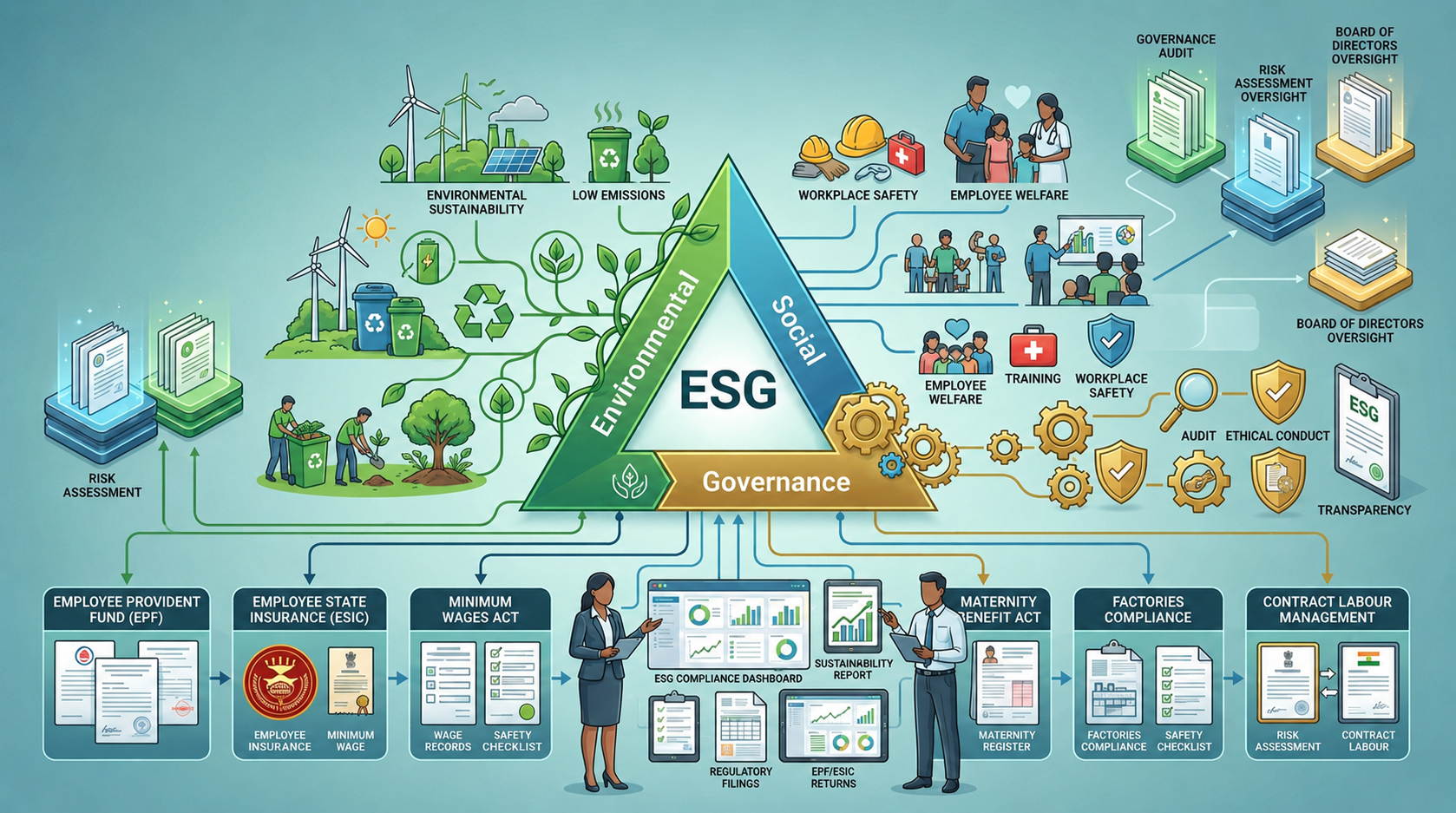
Compliance Outsourcing and ESG: How Statutory Compliance Supports Your 2022 Sustainability Agenda
Discover how statutory compliance strengthens ESG and BRSR reporting in India. Learn how labour law compliance supports sustainability and governance goals.
- Compliance Outsourcing
Discover how statutory compliance strengthens ESG and BRSR reporting in India. Learn how labour law compliance supports sustainability and governance goals.