
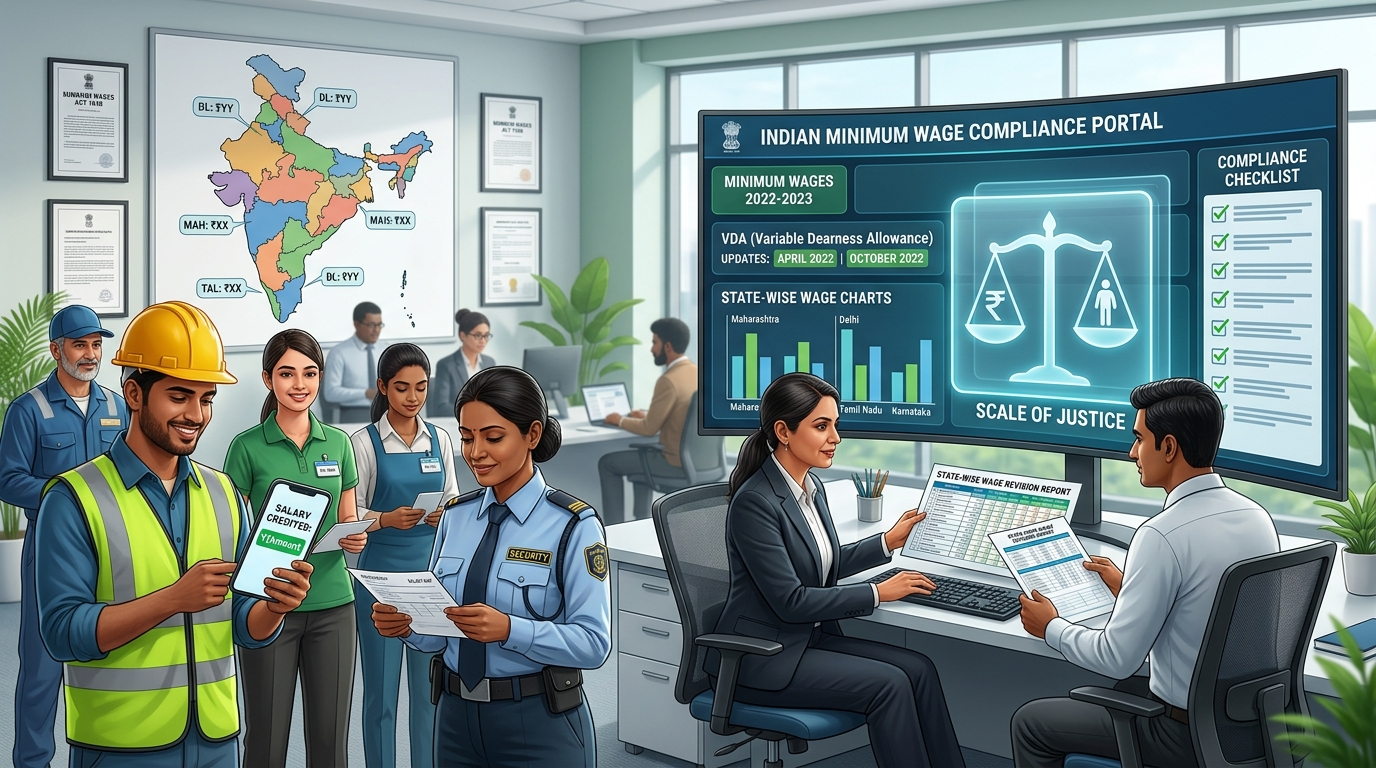
Minimum Wages Compliance in 2022: An Employer's Complete Guide
Learn about minimum wages compliance in 2022, including central and state wage rules, VDA revisions and employer obligations under Indian labour laws.
Minimum wage law in India operates at two levels: central minimum wages fixed by the central government for scheduled employments in establishments under its jurisdiction, and state minimum wages fixed by respective state governments for a wider range of employments. The minimum wage represents the legal floor below which no employer can pay an employee for work performed. In 2022, with inflationary pressures, cost-of-living increases, and the upcoming implementation of the Code on Wages, minimum wage compliance became one of the most dynamic and consequential areas of labour law.
The Legal Framework
The Minimum Wages Act, 1948 empowers both the central and state governments to fix, revise, and enforce minimum wages for scheduled employments. The central government fixes minimum wages for railways, mines, oil fields, and major ports. State governments fix minimum wages for a wide range of employments including construction, agriculture, domestic work, retail, IT and ITES (in some states), security services, and many other sectors. Minimum wages are revised twice a year (in April and October) to account for the Cost of Living Index (Variable Dearness Allowance or VDA). Employers must pay at least the applicable minimum wage and must post it prominently at the workplace.
Components of Minimum Wage
Minimum wages typically have two components: a basic rate and a special allowance or Variable Dearness Allowance (VDA). The VDA is revised bi-annually based on changes in the Consumer Price Index (CPI). Employers must ensure that the sum of basic wages and VDA paid to employees meets or exceeds the applicable minimum wage. Payment of a consolidated amount that equals or exceeds the minimum wage is permissible provided the payslip clearly reflects the components.
2022 Minimum Wage Revisions
Across India, states revised minimum wages in April and October 2022. Delhi revised its minimum wages in October 2022 to Rs. 17,234 per month for unskilled workers, Rs. 19,065 for semi-skilled workers, and Rs. 20,903 for skilled workers, among the highest in the country. Maharashtra revised rates for multiple categories of scheduled employments. Karnataka also revised minimum wages for construction, domestic work, security, and hospitality sectors. The central government revised the national minimum wage (advisory rate) to Rs. 178 per day for Zone A areas.
The Code on Wages and the Universal Minimum Wage
The Code on Wages, 2019, when implemented, will introduce a concept of a national floor wage below which no state can set its minimum wages. The national floor wage acts as the constitutional baseline for wage protection across the country. In 2022, with the Code pending implementation, discussions around the appropriate level of the national floor wage (expected to be in the range of Rs. 178 to Rs. 215 per day for different geographic zones) were actively underway. This structural change will harmonize the currently fragmented state-wise minimum wage landscape.
Compliance and Enforcement
Employers must maintain a register of employees (Form I) showing the hours of work, the wages paid, and deductions made. An abstract of the Act must be displayed at the workplace. The Inspector under the Act can inspect records, examine wages, and file complaints for violations. Non-payment or underpayment of minimum wages is a cognizable offence attracting imprisonment up to 5 years and fines up to Rs. 10,000 under the Act. Under the Code on Wages, the penalty regime is revised with enhanced fines.
Conclusion
Minimum wage compliance is the most direct expression of an employer's respect for the labour of their workers. Staying current with bi-annual revisions and state-specific schedules is a non-negotiable compliance discipline.
Need help navigating compliance? Kriotech HR Management offers end-to-end support for all statutory registrations and licensing requirements. Visit us at https://kriotech.in/ or reach out today.
Speed Optimized
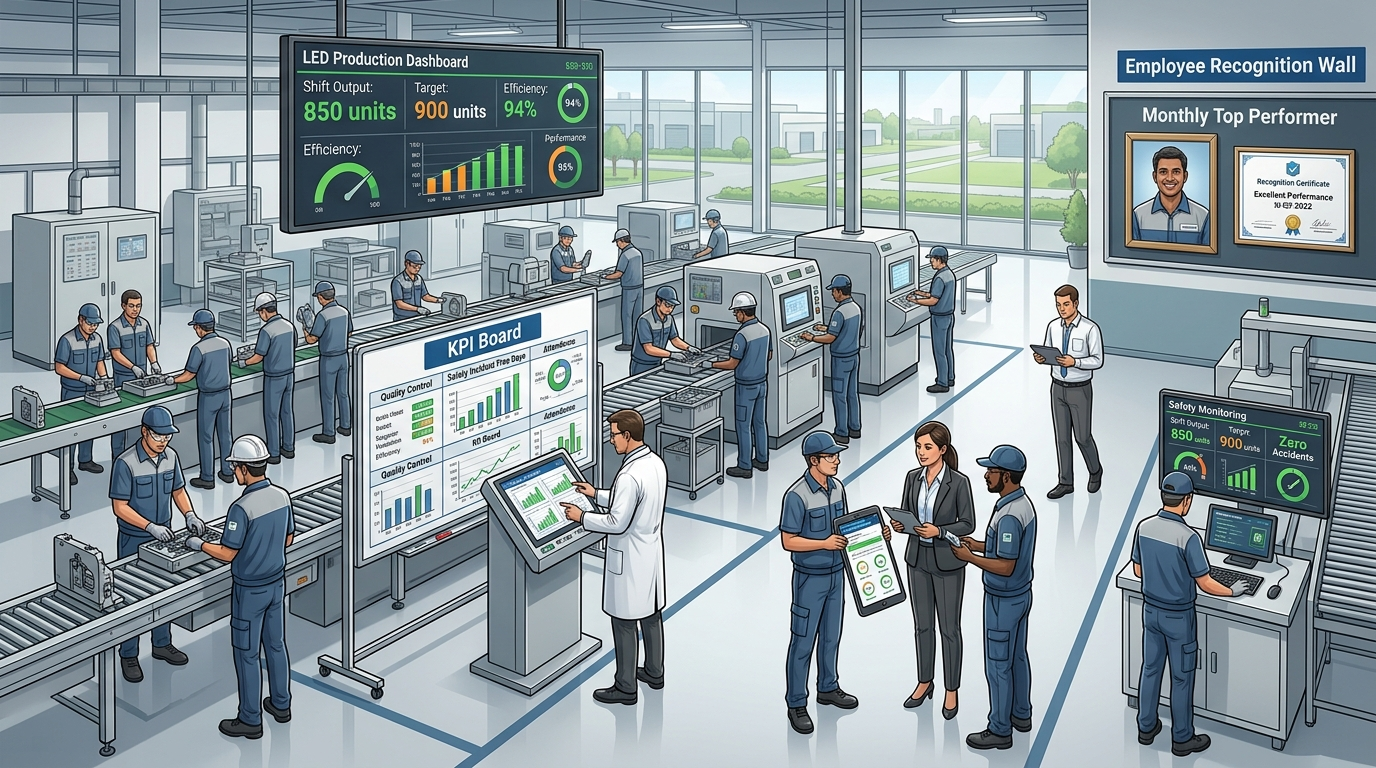
Performance Management for Manufacturing and Factory Businesses: A Practical Guide for 2022
Learn how manufacturing businesses can build practical performance management systems with KRAs, KPIs, safety metrics, and production accountability in 2022.
- KRA / KPI & Performance Advisory
Learn how manufacturing businesses can build practical performance management systems with KRAs, KPIs, safety metrics, and production accountability in 2022.