
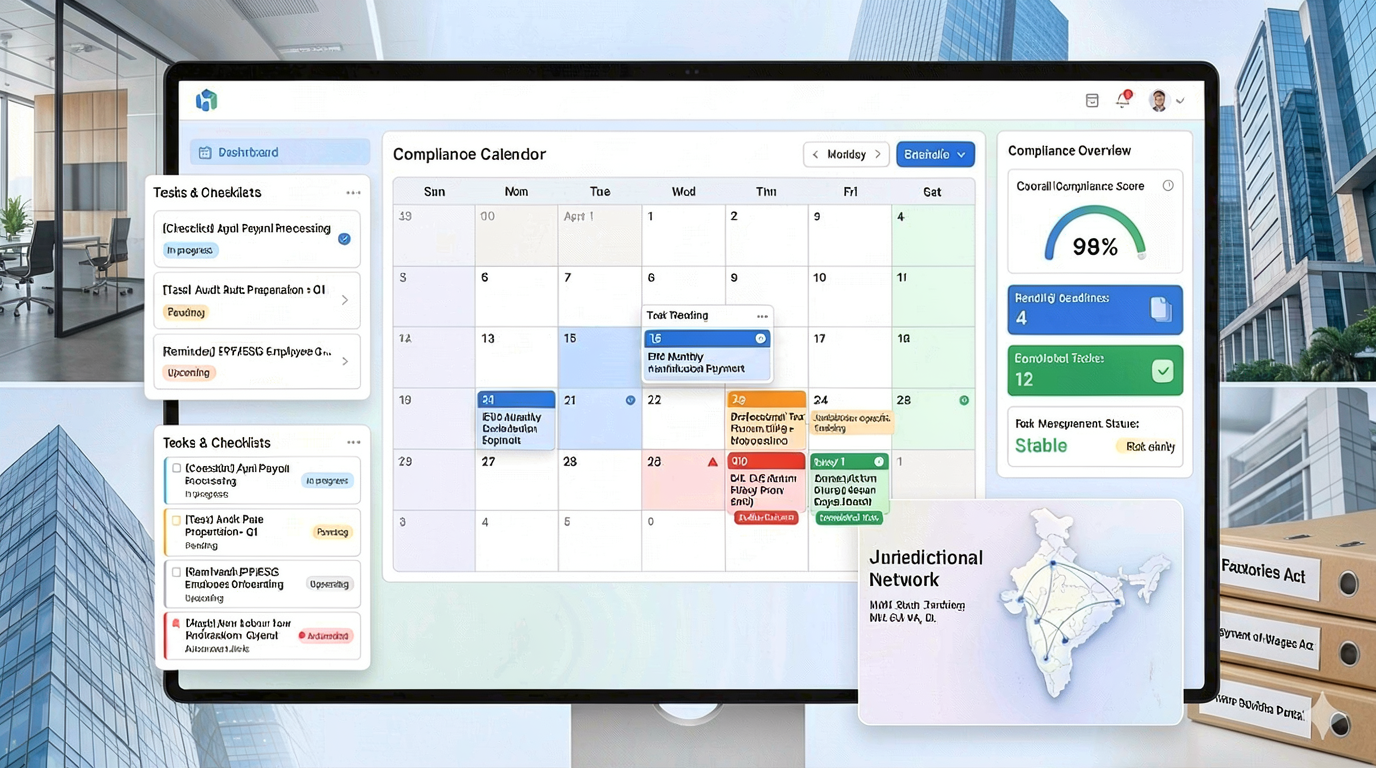
Building a Compliance Calendar: The Operational Foundation of Statutory Risk Management
Learn how a structured compliance calendar helps Indian employers manage EPF, ESIC, minimum wages and labour law deadlines with confidence in 2022.
The compliance calendar is the operational heartbeat of statutory compliance management. It is the tool that translates a complex, multi-statute, multi-deadline compliance obligation matrix into a manageable, prioritised, accountable work plan. Organisations that manage compliance without a systematic compliance calendar are, by definition, relying on individual memory and informal tracking, which creates the same single-point-of-failure risk that a compliance calendar is designed to eliminate.
What a Compliance Calendar Covers
A comprehensive compliance calendar for an Indian employer maps every statutory filing deadline, payment due date, registration renewal requirement, return submission date, and register maintenance milestone across every applicable statute. For a typical Indian employer with operations in two to three states, this calendar covers: EPF monthly ECR filing and payment by the 15th; ESIC monthly contribution filing and payment by the 15th; Professional Tax monthly or quarterly payment and annual registration renewals by state; Payment of Bonus within eight months of the accounting year; Gratuity payments within 30 days of trigger events; Minimum wages rate review and payroll update on state notification; Annual returns under the Minimum Wages Act, Payment of Wages Act, and other applicable statutes; Half-yearly ESIC returns in April-September and October-March cycles; Factories Act annual and half-yearly returns where applicable; Shops and Establishments Act annual renewal.
For each item, the calendar records the deadline, the responsible party, the filing authority, the platform or method of filing, and the confirmation and acknowledgement documentation required.
Why the Calendar Must Be Statute-Specific and Jurisdiction-Specific
A compliance calendar that treats all deadlines as national and uniform misses the most important dimension of India's compliance landscape: its state-level variation. Professional Tax filing frequencies differ by state. Annual return deadlines under the Shops and Establishments Act vary by state. Minimum wages rate revision cycles follow state notification schedules. Factories Act return deadlines are prescribed by state rules.
A compliance calendar that does not reflect these state-specific deadlines is incomplete and provides false assurance. Kriotech HR Management's compliance calendar is built to reflect the specific deadlines applicable in each of our clients' operating jurisdictions, updated in real time as notifications are issued.
The Accountability Structure
A compliance calendar without accountability is a list. The calendar becomes a management tool when each item has a named responsible party, a completion status, and an escalation path for items at risk of missing their deadline. Kriotech HR Management's compliance service integrates the calendar with our internal task management system, ensuring that every deadline has a named team member responsible for delivery and that approaching deadlines trigger automatic review and action.
Regulatory Change Management
A compliance calendar is not a static document. It must be updated continuously as regulatory changes affect deadlines, rates, formats, or filing platforms. In 2022, the active state of India's labour law reform meant that compliance calendar updates were frequent: state notifications of Labour Code rules, minimum wages revisions across multiple states, and EPFO and ESIC portal updates all required corresponding calendar and process adjustments.
Kriotech's regulatory update advisory service, which is part of our compliance outsourcing offering, ensures that our clients are informed promptly of changes that affect their obligations and that the compliance calendar reflects those changes before the next relevant deadline.
Reporting and Visibility
A well-managed compliance calendar generates reporting that gives the leadership team and the board visibility into the organisation's compliance status. Monthly compliance status reports showing completed, pending, and upcoming filings, combined with a running record of acknowledged returns and payment confirmations, provide the documentary evidence of compliance management quality that auditors, investors, and regulators require.
Conclusion
The compliance calendar is not an administrative nicety. It is the operational infrastructure that translates statutory obligations into managed, accountable, documented work. Kriotech HR Management's compliance calendar-driven service model is the operational architecture that ensures no deadline is missed and no obligation is overlooked.
Let Kriotech's compliance calendar work for your organisation. Visit kriotech.in.
Speed Optimized

The ROI of Mentorship: How to Measure What Matters in 2022
Discover how businesses can measure the real ROI of mentorship in 2022 through stronger leadership, higher retention, faster promotions, better decisions and sustainable growth.
- Mentorship
Discover how businesses can measure the real ROI of mentorship in 2022 through stronger leadership, higher retention, faster promotions, better decisions and sustainable growth.