
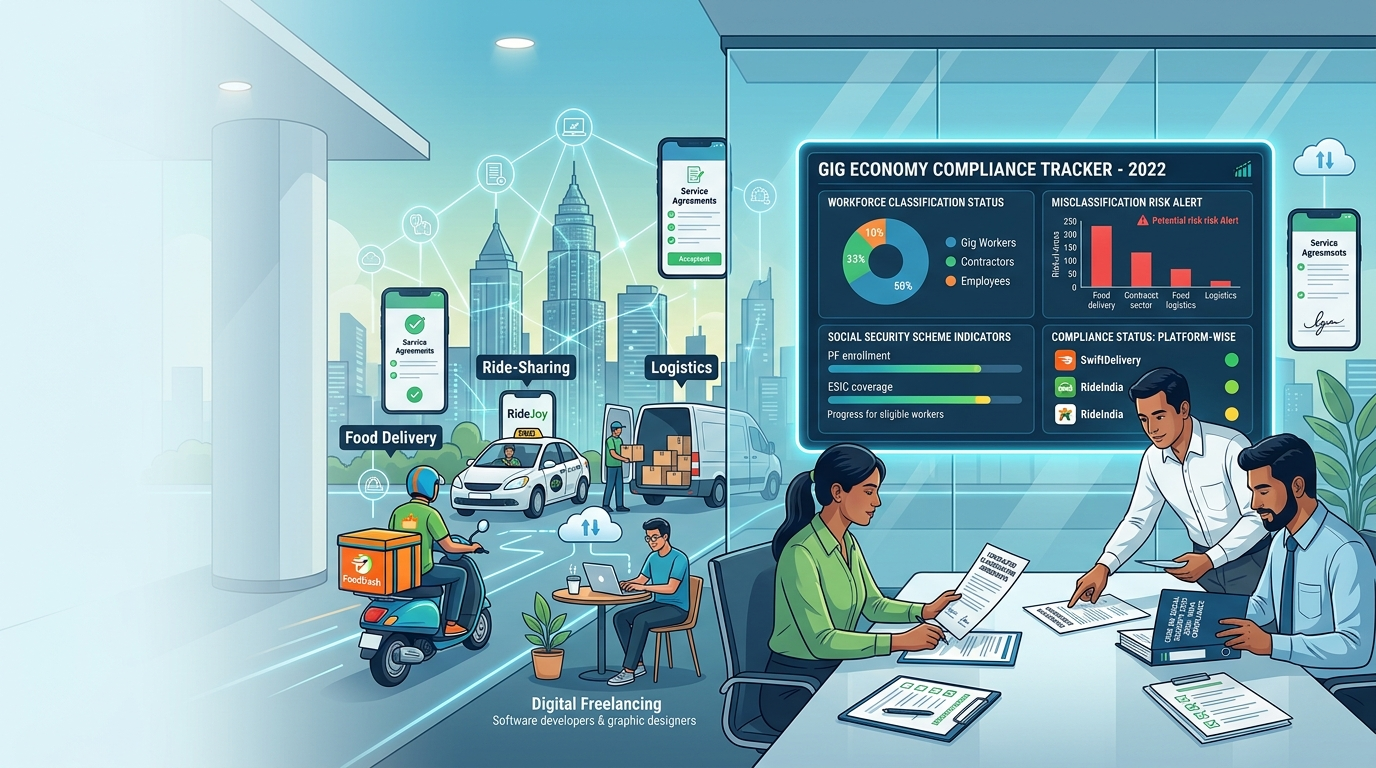
Compliance for the Gig Economy: Managing New Worker Category Obligations in 2022
Explore compliance challenges in India’s gig economy. Learn about gig worker classification, legal risks, and evolving social security obligations.
India's gig economy expanded dramatically through 2022. NITI Aayog's 2022 report estimated India's gig workforce at 7.7 million, projected to reach 23.5 million by 2030. For organisations that engage gig workers, platform workers, freelancers, and contract workers, the compliance landscape was evolving in ways that made traditional approaches to non-employee engagement increasingly difficult to sustain.
The Code on Social Security and Gig Workers
The Code on Social Security 2020 is the first piece of central Indian legislation to formally recognise gig workers and platform workers as categories entitled to social security benefits. Section 1(3)(d) defines a gig worker as a person who performs work or participates in a work arrangement and earns from such activities, outside of a traditional employer-employee relationship.
The Code requires the central government to formulate welfare schemes for gig and platform workers covering life and disability insurance, accident insurance, health and maternity benefits, old age protection, and other benefits as determined. While the specific schemes were still being developed during 2022, the direction of legislative intent was clear: engagement of gig workers would carry increasing social security obligations for engaging organisations.
Misclassification Risk: The Growing Compliance Exposure
Worker misclassification, the treatment of a functionally employed worker as an independent contractor, represents one of the most significant and growing compliance risks in India's gig economy context. The consequences of successful misclassification claims include retrospective payment of EPF contributions, ESIC contributions, gratuity, and other statutory benefits from the date of engagement, potentially spanning multiple years and covering large numbers of workers.
Indian courts apply a multi-factor test to determine employment status, examining the degree of control exercised by the engaging organisation, exclusivity of service, integration into the organisation's operations, and the economic reality of the relationship. Organisations engaging large numbers of gig workers should conduct a compliance risk assessment of their engagement structures against this test.
Contract Labour Compliance for Platform-Based Businesses
Platform-based businesses that engage workers through third-party labour contractors remain subject to the Contract Labour (Regulation and Abolition) Act 1970 for those workers. The principal employer registration requirement, contractor licensing verification, and principal employer liability for contractor non-compliance apply to digital platform businesses as surely as to traditional industrial establishments.
Kriotech HR Management's compliance service helps platform-based organisations structure their contractor relationships in ways that meet the Act's requirements and document the compliance trail that protects them in the event of an inspection or worker claim.
The Karnataka Gig Workers Welfare Bill 2021
Karnataka became the first Indian state to move toward dedicated gig worker protection legislation with the Gig Workers Welfare Bill 2021, which was under active development during 2022. The Bill proposed a welfare fund for gig workers, registration requirements for platform companies, and dispute resolution mechanisms. While not yet enacted during 2022, the Bill signalled the direction of state-level legislative activity on gig worker protection across India.
Organisations with significant gig worker populations in Karnataka and other states where similar legislation was being developed needed to monitor these developments closely and build operational flexibility into their engagement structures.
Building Compliance Infrastructure for the Contingent Workforce
The most practical compliance approach for organisations with significant gig and contract worker populations in 2022 was to build compliance infrastructure that could flex as the regulatory framework evolved. This meant documenting current engagement structures, conducting misclassification risk assessments, establishing monitoring processes for contractor compliance, and maintaining records that would demonstrate good faith compliance in any future regulatory review.
Conclusion
The gig economy's regulatory framework is evolving rapidly. Organisations that build proactive compliance infrastructure now will be far better positioned for the expanding obligations ahead than those that wait for regulatory certainty before acting. Kriotech HR Management helps organisations build this infrastructure with current knowledge and forward-looking design.
Build compliance infrastructure for your evolving workforce. Contact Kriotech HR Management at kriotech.in.
Speed Optimized

Digital Signature Certificate (DSC) Registration: The Foundation of E-Compliance
Learn about Digital Signature Certificate (DSC) registration in India, its types, uses for MCA, GST, EPF filings, and why it's essential in 2022.
- Licensing & Statutory Registrations
Learn about Digital Signature Certificate (DSC) registration in India, its types, uses for MCA, GST, EPF filings, and why it's essential in 2022.