
Compliance Outsourcing for Multi-State Operations: Managing India's 36-Jurisdiction Challenge
Understand multi-state labour law compliance in India and learn how businesses can manage state-specific regulations and compliance risks in 2022.
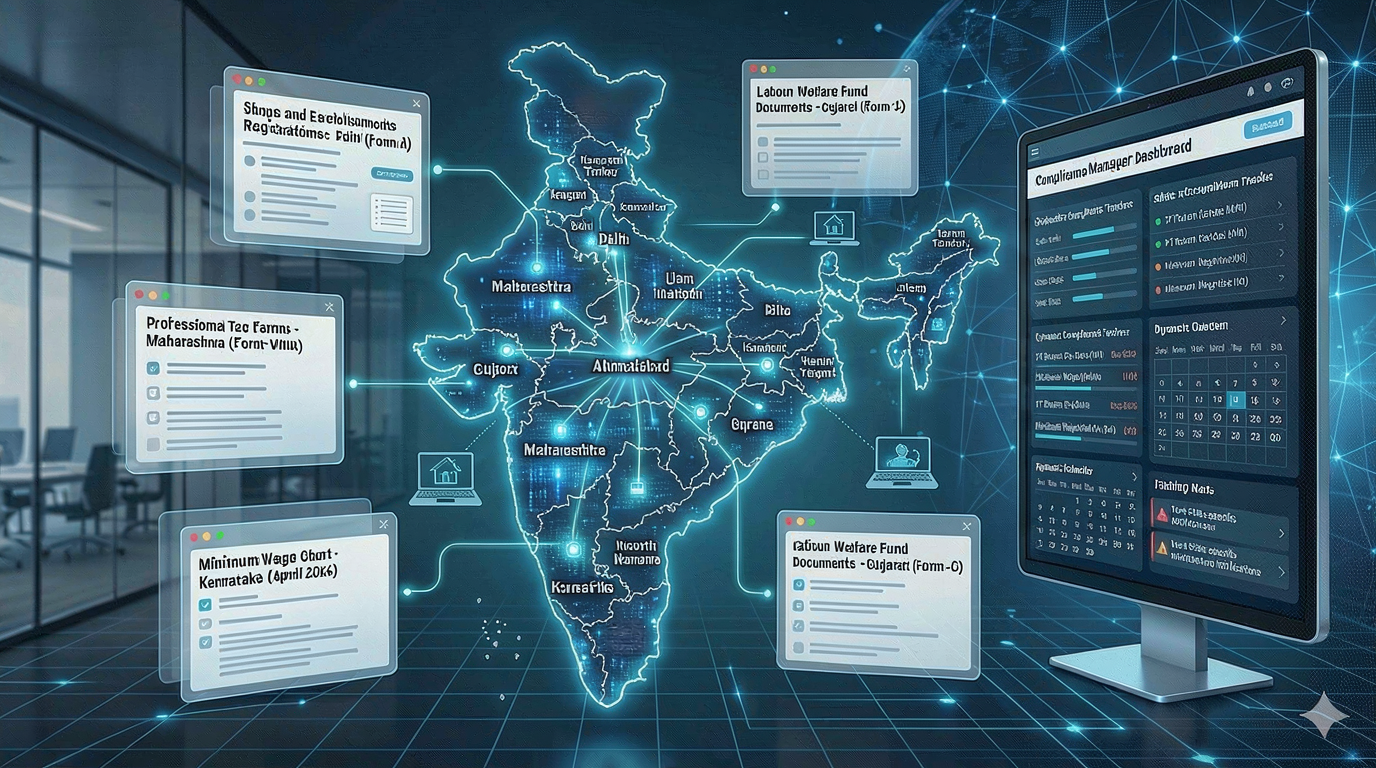
India's federal structure creates one of the world's most complex compliance environments for multi-state employers. With 28 states and 8 union territories, each with their own Shops and Establishments legislation, Professional Tax framework, state-specific minimum wages, and state-level modifications to central labour statutes, an organisation operating across India's major commercial centres is, in effect, managing compliance in multiple distinct regulatory jurisdictions simultaneously. In 2022, as organisations expanded geographically in response to economic growth and as remote work created new state-presence questions, multi-state compliance management became a strategic capability requirement.
The Multi-Jurisdiction Compliance Matrix
For an organisation with operations in Maharashtra, Karnataka, Delhi, Tamil Nadu, Gujarat, and Telangana, the compliance matrix spans: six separate Shops and Establishments Act registrations with different annual renewal deadlines and fee structures; Professional Tax obligations in Maharashtra, Karnataka, Tamil Nadu, and Telangana (Gujarat and Delhi do not levy Professional Tax); minimum wages applicable to the relevant industry and skill categories in each state, revised on different cycles; state-specific leave entitlement rules that may exceed the minimums in the central code; and state labour welfare fund contributions in applicable states.
Add to this the variable pace of Labour Code state rule implementation across each jurisdiction, and the compliance manager faces a genuinely dynamic multi-jurisdiction obligation set.
Shops and Establishments Act: The Foundation Compliance
Every commercial establishment operating in India must register under the applicable state Shops and Establishments Act before commencing operations. The registration specifies the establishment name, address, nature of business, number of employees, and working hours. Annual renewals are required in most states, and any changes to the establishment, including change of address, change of name, or significant changes in employee numbers, require amendment filings.
Operating without registration, operating with an expired registration, or operating with inaccurate registration details are each compliance failures that carry penalties and can result in directions to cease operations during an inspection. For organisations that have expanded to new locations or onboarded remote employees in new states without completing the relevant registration, the non-compliance may be long-standing without being visible.
State Labour Welfare Fund Contributions
Several Indian states levy a Labour Welfare Fund contribution, payable by both the employer and the employee, for the benefit of the state's registered labour welfare fund schemes. The states with active Labour Welfare Fund contributions include Maharashtra, Karnataka, Andhra Pradesh, Telangana, Tamil Nadu, Gujarat, and others. Contribution rates, calculation bases, and payment frequencies vary by state.
Like Professional Tax, the Labour Welfare Fund creates a state-specific obligation that organisations often discover only when an inspection or notice reveals the non-registration and arrears liability.
Remote Work and New State Presence
The proliferation of remote work in 2022 created a new category of multi-state compliance question: when an employee works permanently from a state where the employer has no registered office, does the employer have an obligation to register under that state's Shops and Establishments Act? The answer, in most states, is that the employee's place of work, even if it is a home office, creates a registration obligation.
Organisations with permanent remote employees in multiple states that had not assessed or addressed this question were carrying registration gaps that would become visible in an inspection or investigation.
Kriotech's Multi-State Compliance Architecture
Kriotech HR Management manages multi-state compliance through a structured jurisdiction-specific framework: separate compliance calendars for each operating state, current knowledge of state-specific obligations maintained through ongoing regulatory monitoring, and a centralised reporting structure that gives the client organisation a consolidated view of its compliance status across all jurisdictions. Our service scales efficiently as organisations expand to new states, adding the relevant compliance framework for each new jurisdiction without the client needing to manage the regulatory research independently.
Conclusion
Multi-state compliance is a specialist capability. The organisations that manage it well are those that have invested in the dedicated infrastructure, whether in-house or through a specialist partner like Kriotech HR Management, to track, manage, and document their obligations across every operating jurisdiction.
Manage multi-state compliance with one expert partner. Contact Kriotech HR Management at kriotech.in.
Speed Optimized

Hybrid Work and Payroll Compliance in 2022: How Businesses Are Managing the New Reality
Learn how hybrid work is reshaping payroll compliance in India. Explore PT, ESIC, WFH allowance taxation, gig worker regulations, and payroll outsourcing solutions.
- Payroll Outsourcing
Learn how hybrid work is reshaping payroll compliance in India. Explore PT, ESIC, WFH allowance taxation, gig worker regulations, and payroll outsourcing solutions.