
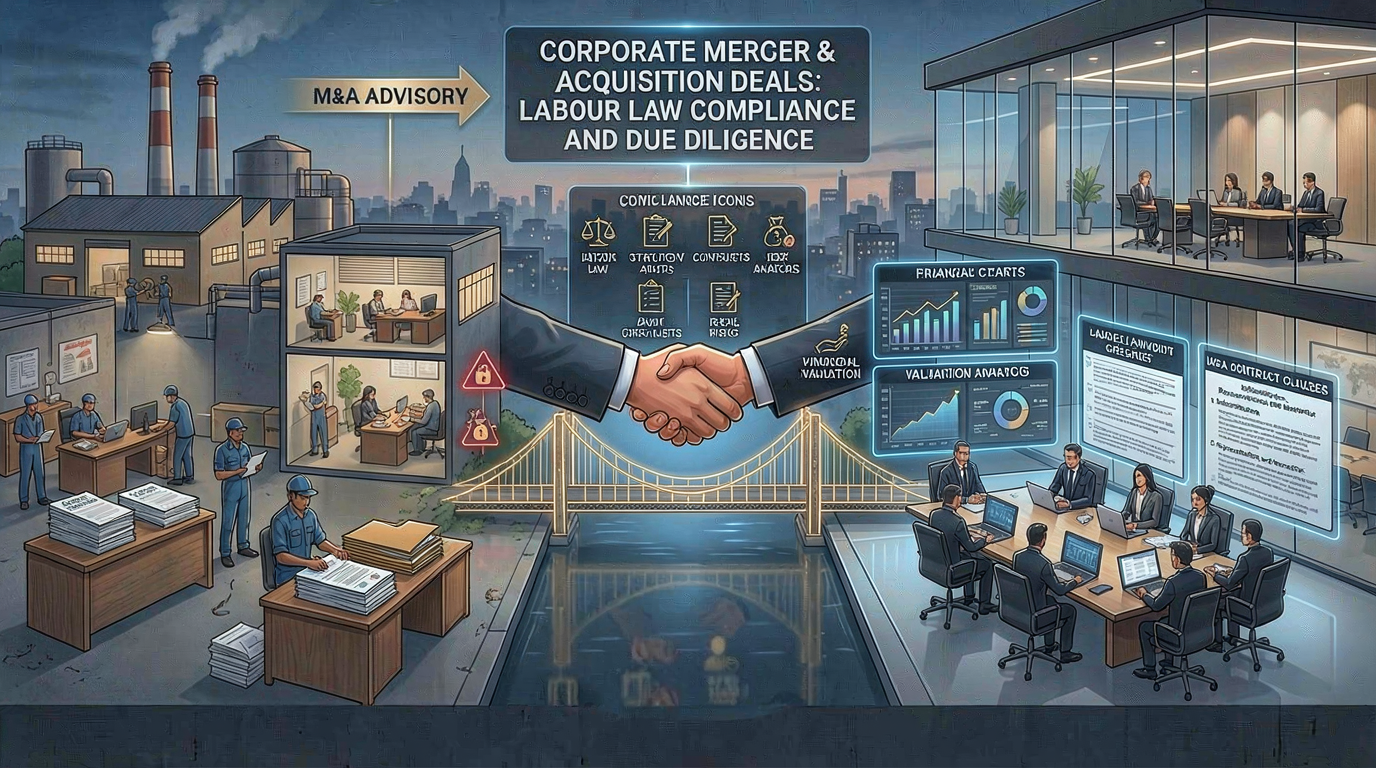
Compliance Due Diligence in M&A Transactions: Why Labour Law Matters in 2022 Deals
Discover why labour law compliance is crucial in M&A deals and how EPF, ESIC, gratuity and other liabilities impact valuation and integration in 2022.
Mergers, acquisitions, and business transfers in India carry statutory compliance dimensions that are frequently under-assessed in due diligence, to the significant financial detriment of acquiring organisations. When a business is acquired, the buyer typically inherits not only its assets and contracts but also its pending and undiscovered labour compliance liabilities. In 2022, a period of active M&A activity across Indian sectors driven by post-pandemic consolidation and restructuring, the quality of compliance due diligence became a material factor in deal valuation and risk allocation.
What Gets Inherited in a Business Transfer
Under Indian law, several statutory obligations transfer with the business in an asset acquisition or merger. Under the EPF Act, if the acquired business was covered under the Act, the acquiring employer inherits the compliance obligations and any pending liabilities. Under the Payment of Gratuity Act, employees' past service with the acquired company counts toward gratuity eligibility with the new employer upon change of ownership, meaning that long-serving employees carry their accumulated gratuity liability into the new ownership structure.
Under the Industrial Disputes Act, workers employed in the transferred undertaking are entitled to specific protections regarding their service conditions. Section 25FF of the Industrial Disputes Act requires that workers receive retrenchment compensation equivalent to notice pay in the event of a change of ownership, unless continuity of employment is assured on terms no less favourable.
The Labour Compliance Due Diligence Checklist
A thorough labour compliance due diligence for an Indian acquisition covers: EPF registration status and any pending enforcement proceedings or Section 14B damages; ESIC registration completeness and contribution accuracy history; Gratuity fund status and actuarial liability quantification; Outstanding wages and bonus claims; Pending labour disputes and grievances; Contractor engagement structures and potential misclassification risk; Pending or threatened labour inspections or notices; Compliance with applicable minimum wages across all worker categories; Standing order certification status and employee notice period obligations; POSH compliance history including any pending ICC proceedings.
The Consequences of Incomplete Due Diligence
The consequences of discovering labour compliance liabilities post-acquisition are typically more expensive than addressing them pre-acquisition. The buyer loses negotiating leverage, cannot seek contractual protection against liabilities it has already assumed, and faces the operational disruption of managing legacy compliance issues alongside the challenges of integration.
In several high-profile Indian M&A transactions in recent years, undisclosed or inadequately assessed labour liabilities, including EPF Section 14B damages, pending minimum wages disputes, and undisclosed bonus arrears, have resulted in post-closing financial adjustments and litigation between buyers and sellers.
Pre-Transaction Compliance Remediation
For sellers preparing a business for transaction, a pre-transaction compliance review and remediation exercise serves both commercial and legal purposes. A clean compliance record enhances transaction value and simplifies deal negotiations. Sellers who have actively managed their compliance obligations are better positioned to provide comprehensive warranties and to support the buyer's due diligence process efficiently.
Kriotech HR Management conducts pre-transaction compliance reviews that identify and, where possible, remediate compliance gaps before the transaction process begins. This is one of the highest-value engagements we provide, with the potential to materially affect transaction outcomes.
Post-Acquisition Compliance Integration
Following an acquisition, the integration of the acquired business's compliance obligations into the acquiring organisation's compliance framework must be managed carefully. New establishments must be added to compliance registrations, contribution calculations must reflect any restructured compensation, employee documentation must be consolidated, and any inherited compliance gaps must be addressed on a documented timeline.
Conclusion
Labour compliance is a material factor in Indian M&A transactions. Buyers who underestimate it acquire liabilities they did not price. Sellers who manage it well create transaction value. Kriotech HR Management supports both sides of this equation with expert compliance assessment and remediation services.
Protect your transaction value with expert compliance due diligence. Contact Kriotech HR Management at kriotech.in.
Speed Optimized

Trade License: Why Your Business Needs One Before Day One
Learn about Trade License requirements in India, eligibility, application process, renewal rules, municipal compliance, and penalties for businesses in 2022.
- Licensing & Statutory Registrations
Learn about Trade License requirements in India, eligibility, application process, renewal rules, municipal compliance, and penalties for businesses in 2022.